
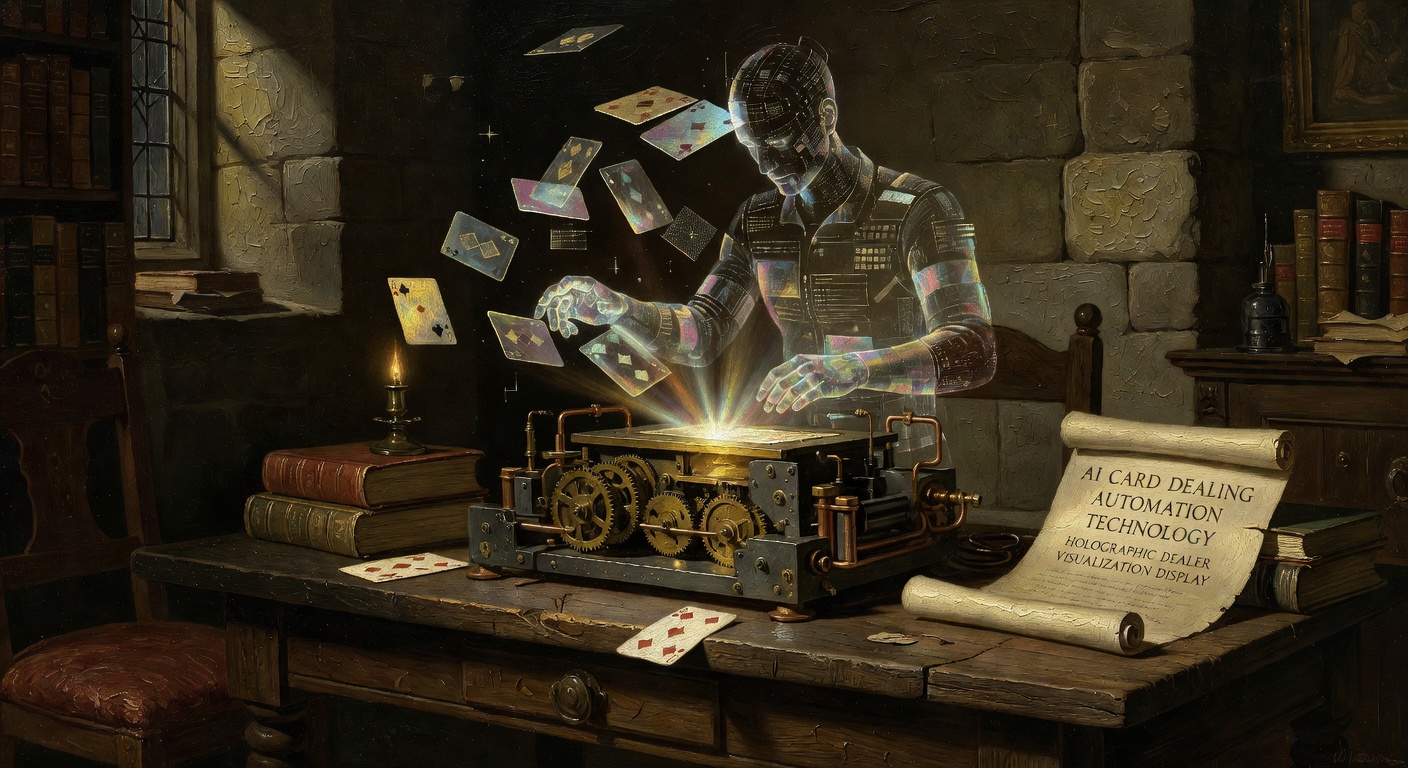
How AI Dealers Could Change Online Table Games
What is a dealer? Is it a function, or is it a presence? If an AI can shuffle cards and announce results, has anything changed? Or have we only revealed what was always true about dealing.
Words by Buddy Grant4 min read
What is a dealer? Is it a function, or is it a presence? If an AI can shuffle cards and announce results, has anything changed? Or have we only revealed what was always true about dealing.
AI dealers are a emerging technology in online casinos. Instead of a human dealer at a physical table (or a pre-recorded dealer in a live studio), an AI system handles the game.
The Technical Implementation
An AI dealer would:
- Process player input (bet placed, card drawn).
- Execute game logic (shuffle, deal, determine outcome).
- Communicate the result (card position, outcome announced).
- Generate a visual representation (animated dealer, animated cards).
All of this can be done in real-time with no human involvement. The system is essentially a sophisticated chatbot with game logic.
Computer vision can track physical cards (for hybrid live-AI systems).
The Current State
AI dealers do not yet exist in production casinos. But the technology is advancing. Large language models can process game logic and generate realistic-sounding dealer patter ("The dealer hits on 16, stands on 17").
Computer vision can track physical cards (for hybrid live-AI systems). Animation can be generated in real-time or pre-rendered.
The technology is close. A functioning AI dealer is probably 2-5 years away.
The Advantages
For the casino:
- No labor costs. A human dealer costs 30,000 to 100,000 dollars per year. An AI costs server costs (minimal).
- Consistency. An AI dealer never has a bad day, never gets tired, never makes errors.
- Scalability. One AI can handle 1,000 concurrent tables. One human can handle one table.
- Customization. The AI can be programmed to match any desired personality (friendly, efficient, mysterious).
For the player:
- Availability. Games run 24/7 without staffing constraints.
- No awkwardness. No interaction with a real person.
- Potential cost savings (lower overhead might mean better payouts, though this is unlikely).
The Disadvantages
For the player:
- Loss of human connection. A live dealer provides social interaction. An AI provides illusion of social interaction.
- Uncanny valley. An AI that sounds almost human but not quite can be unsettling.
- Philosophical uncertainty. Is the game actually fair if an AI controls it? (Unfounded worry, but psychologically real.)
For the casino:
- Regulatory uncertainty. Regulators might not allow AI dealers in licensed jurisdictions.
- Customer backlash. Some players might refuse to play against AI.
- Technical failure risk. An AI system can fail in ways a human cannot. A human dealer can catch errors; an AI might not.
The Experience Design
An AI dealer would likely be designed as a humanoid avatar. The avatar would make appropriate gestures (shuffling, dealing), make eye contact (via camera), and speak in natural language.
The avatar would probably be designed to be helpful and neutral. A too-friendly AI might feel patronizing. A too-cold AI might feel inhuman.
The Philosophical Question
A live dealer game feels fair because a human is conducting it. There is agency, presence, responsibility. A human dealer cannot be programmed to cheat (though they could cheat for personal gain).
An AI dealer is a software system. It can be programmed to cheat. It can have bugs that advantage the house. There is no human agent responsible; there is only code.
The player must trust the AI system the way they trust a slot machine. The system is certified (presumably), but the player cannot see inside it. The AI is a black box.
The Regulatory Path
For AI dealers to be used in regulated jurisdictions (UK, Malta), the AI system would need to be certified like an RNG is certified. The AI's decision-making would need to be audited and verified as fair.
This is technically possible but complex. An RNG can be tested for statistical randomness. An AI dealer's behavior would need to be tested for bias in ways that an RNG is not.
The Market Prediction
AI dealers are likely to arrive first in unregulated crypto casinos. An unlicensed casino has no regulatory barriers to using AI.
Regulated casinos might adopt AI dealers for non-critical games (slots, RNG games) but resist AI for table games that are traditionally dealt by humans.
Over 10-20 years, as AI technology improves and becomes familiar, regulated casinos might gradually adopt AI dealers.
The Larger Meaning
AI dealers reveal something about the nature of gambling. The dealer is ultimately irrelevant. What matters is the outcome (determined by software or physics) and the experience (human or AI interaction).
A human dealer provides the illusion of fairness and human stakes. An AI dealer removes the illusion and makes explicit what was always true: the outcome is determined by a system, and the player's agency is limited to deciding how much to bet.
The Socratic insight is that by removing the human, we see the system more clearly. An AI dealer is not fundamentally different from a live dealer. Both are executing a game determined in advance by mathematics. The AI simply makes this explicit.
The Final Question
Will players accept AI dealers? Will the loss of human presence change how people experience gambling? Or will the convenience and consistency of AI outweigh the psychological value of human interaction?
These questions cannot be answered until the technology exists and is widely used. But the technology is coming.