
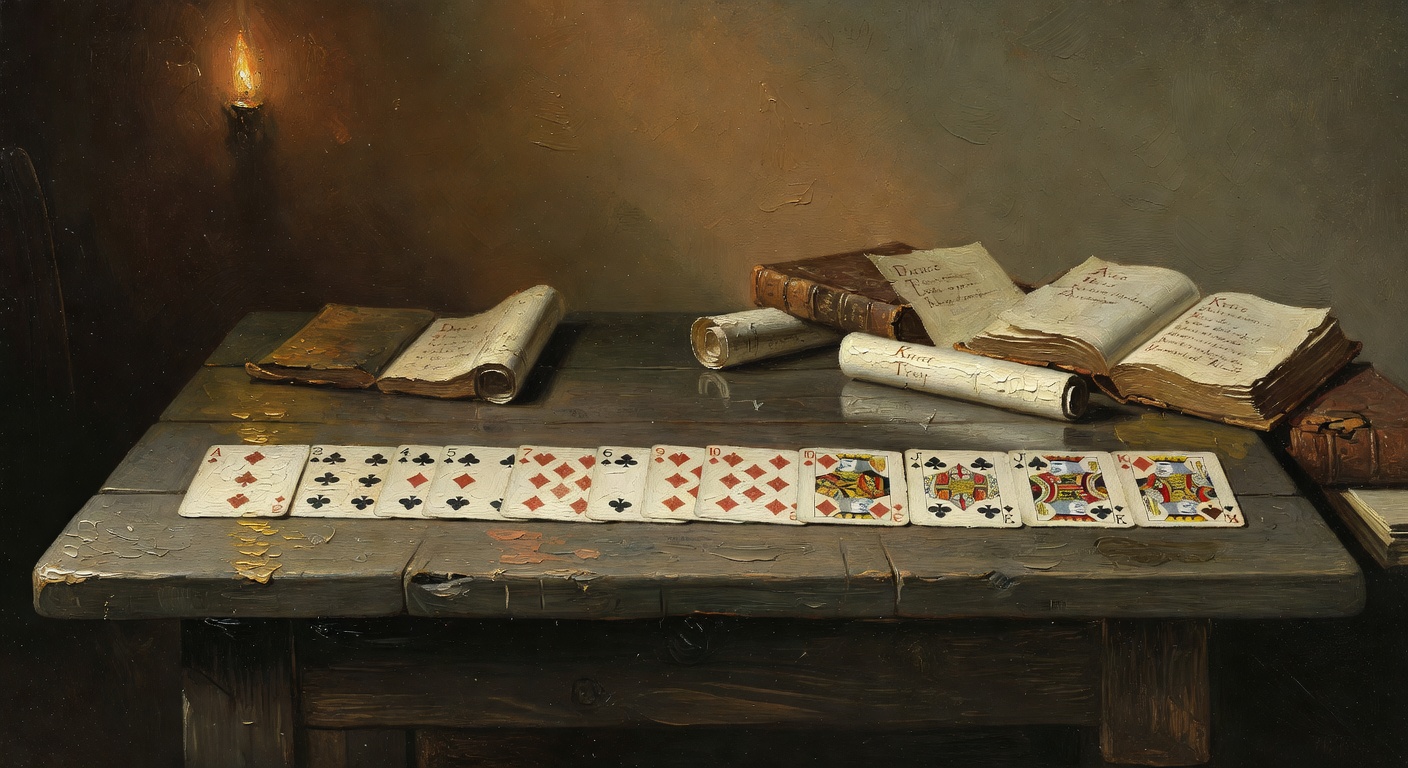
Blackjack started in French casinos as Vingt-et-Un, a game where 21 was the goal and anything over was a bust. It migrated to America, mutated, and became the best odds in the casino. The story of how is the story of a game constantly defending itself against people trying to beat it.
Vingt-et-Un (1600s)
Vingt-et-Un, French for twenty-one, appears in writings as early as the 1600s. The game is simple: player and dealer each receive cards, trying to reach 21 without going over. Bust and you lose automatically. The player acts first. If the player busts, the dealer wins without playing his hand. This is a major disadvantage for the player.
The game had no standard rules. Different casinos, different versions. Some allowed doubling down (doubling the bet and receiving exactly one more card). Some allowed splitting pairs. Some did not.
When the game migrated to America in the 1800s, it was called Blackjack (though the name originally referred to a specific hand: an Ace and a black Jack).
Early American Blackjack (1800s)
When the game migrated to America in the 1800s, it was called Blackjack (though the name originally referred to a specific hand: an Ace and a black Jack). American casinos standardised some rules. Doubling was allowed. Splitting was allowed. The game became more player-friendly.
But even in the 1800s, casinos had to deal with card counters. A skilled player could keep a rough count of what cards had been dealt and adjust bets accordingly. High cards favour the player (more blackjacks, more ability to hit stiff hands safely). Low cards favour the dealer (more busts for the player).
Casinos added decks. Started with one deck, moved to two, then four, then six, then eight. More decks make card counting harder because you have to track more cards.
The Vegas Era (1940s-1950s)
When Las Vegas opened casinos in the 1940s, blackjack was a popular game but casinos did not understand how to price it. The house edge should have been roughly 1 percent if the casino was offering reasonable rules. But casinos offered generous rules (liberal doubling, early surrender, resplitting aces) and the house edge was sometimes under 1 percent.
Casinos were not sure about this. They thought blackjack was too player-friendly. But they noticed that players lost money anyway, so they kept the game.
In 1962, a mathematician named Ed Thorp published "Beat the Dealer," which explained card counting mathematically.
The MIT Card Counting Teams (1970s-1990s)
In 1962, a mathematician named Ed Thorp published "Beat the Dealer," which explained card counting mathematically. Thorp showed that with a simple counting system (keeping track of whether high or low cards remained in the deck), a player could achieve a small edge over the house.
Card counting is not illegal. But casinos can refuse service to counters. So a small business emerged: recruiting smart people, training them to count cards, and sending them into casinos to play blackjack.
The most famous card counting team was the MIT Card Counting Team, students from MIT who counted cards at casinos in Las Vegas and Atlantic City. They were successful for years, winning hundreds of thousands. Eventually, casinos caught on and started banning them.
The Response: Continuous Shufflers
Casinos fought back with continuous shuffling machines (CSMs). A CSM shuffles the deck after every hand. This makes card counting useless because you cannot track what has been played.
CSM blackjack tables have a higher house edge (usually 1.5 to 2 percent) than standard tables, but casinos advertise them as "faster play." From the casino's perspective, they prevent card counting and attract superstitious players who like the idea of a continuously fresh deck.
Modern Rules Evolution
Over the 1970s and 1980s, casinos gradually reduced player-favorable rules:
- Blackjack payouts dropped from 3-to-2 to 6-to-5 at many tables. This alone increases the house edge from 0.5 percent to 1.4 percent.
- Early surrender (player can surrender before dealer checks for blackjack) was eliminated.
- Double exposure blackjack (both dealer cards face-up) was introduced and then withdrawn because it was too player-friendly.
- The number of decks increased. Single-deck blackjack is now rare.
Modern blackjack at a typical casino has a house edge of 1 to 1.5 percent if the player uses basic strategy (the mathematically optimal play for every possible hand). This is still one of the best odds in the casino.
The Online Shift
Online blackjack uses RNG (random number generation) instead of physical decks. The odds are identical to multi-deck blackjack on the strip (house edge around 0.5 to 1 percent) but card counting is impossible.
Online blackjack also allows more betting flexibility. You can bet as little as 10 cents or as much as 50,000 dollars. Land casinos have minimum bets of 5 to 25 dollars and maximum bets of 5,000 to 10,000 dollars (depending on the table).
The Current State
Blackjack remains one of the best bets in the casino. With basic strategy, the house edge is lower than most games. The game has existed for 400 years and evolved from a French parlour game into a casino staple played worldwide.
The game is also constantly adapting. New rule variants are introduced to increase the house edge. New technology (shufflers, RNG) is introduced to prevent exploitation. The arms race between players trying to beat the game and casinos trying to profit continues, just as it did in the 1960s.