
BlackjackCelebritiesHistoryStrategy
Why Continuous Shuffling Machines Kill Most Advantage Plays
Card counting used to work because casinos shuffled predictably. Continuous shuffling machines changed that equation. Most advantage plays depend on predicting future cards. Machines make prediction impossible.
Words by Carol Feldman3 min read
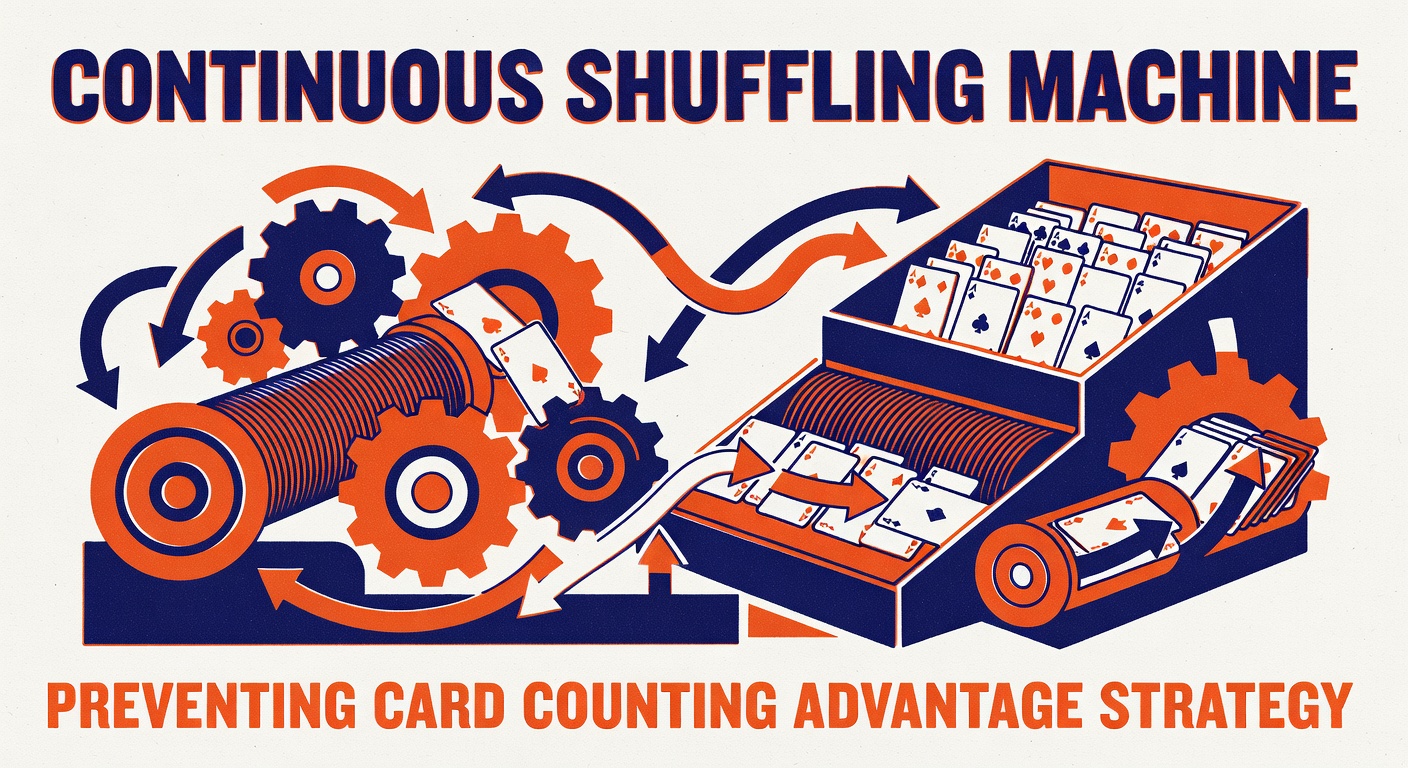
A continuous shuffling machine (CSM) automatically reshuffles cards after every hand or every few hands, returning them to the shoe immediately. The machine eliminates the burned card that casinos use (to prevent card counting from the top of the shoe). The machine also prevents players from tracking the composition of the deck.
Card counting works because it tracks the composition of the remaining deck. As high cards are dealt out, the remaining deck becomes richer in low cards (or vice versa, depending on the count). A counter uses this information to bet larger when the deck is favorable.
A continuous shuffling machine resets the count after every hand or every few hands, making it impossible for a counter to accumulate information about future cards. The deck never gets out of balance because it is reshuffled constantly.
Why Casinos Adopted CSMs
Casinos installed CSMs in the 1990s and 2000s, specifically in response to card counting. The casinos lost millions to counters in the 1980s and 1990s. Installing a CSM was a mechanical way to eliminate the counting advantage.
CSMs also speed up play (no hand-shuffling between rounds) and reduce human dealer errors. From a casino operations perspective, they are superior machines.
Card counting is the most famous advantage play, but it is not the only one.
The Impact on Advantage Play
Card counting is the most famous advantage play, but it is not the only one. Edge sorting (identifying wear marks on cards and using that information to predict specific cards) requires that you can track which specific cards are approaching the player. CSMs make this much harder because cards are constantly reshuffled.
Predictive betting systems (betting more when you expect favorable cards) depend on information about the next card or the next round. CSMs eliminate this advantage because you have no information about the next card.
Advantage plays that depend on identifying non-random dealer behavior (a dealer who is unconsciously biasing their shuffle, a dealer who is dealing from the top of the deck) also become much harder with a CSM because the CSM controls the shuffle, not the dealer.
What Still Works
Basic strategy in blackjack still works, but the edge is the house's edge, not the player's edge. CSMs eliminate the player's ability to overcome the house edge through skill.
Some games remain beatable with CSMs: poker (because you are playing against other players, not against the house), baccarat-adjacent games where bet sequencing provides information (like Dragon Tiger), and games where the CSM itself has a bias (which is extremely rare).
CSMs are now standard in most casinos for blackjack and other card games where advantage play is a concern.
The Current Landscape
CSMs are now standard in most casinos for blackjack and other card games where advantage play is a concern. A player who enters a blackjack game and sees a CSM should understand that card counting is not viable. The player should either play basic strategy and accept the 0.5 percent house edge, or move to a different game.
Some casinos still offer hand-shuffled blackjack, usually in high-limit rooms where sophisticated players demand it. These games sometimes have worse rules (to compensate for the CSM being absent), but they offer the possibility of advantage play for skilled counters.
The Philosophical Impact
CSMs represent a decisive victory for casinos over advantage players. The machine cannot be beaten by technique. It cannot be counted against. It cannot be exploited. It is pure chance.
Before CSMs, a player could imagine that skill and discipline could overcome the house edge. With CSMs, that imagination is cut off. The house edge becomes irrefutable. The machine is fair, random, and unbeatable.
This shift changed how people think about casino games. It ended the era of blackjack as an advantage-play game. It forced advantage players either to move to other games or to improve their technique (creating the sub-category of advantage players who exploit CSM biases, shuffle tracking, dealing errors, etc., but these are rare).
The CSM is not controversial. Casinos have every right to implement it. But it marks the end of an era.