
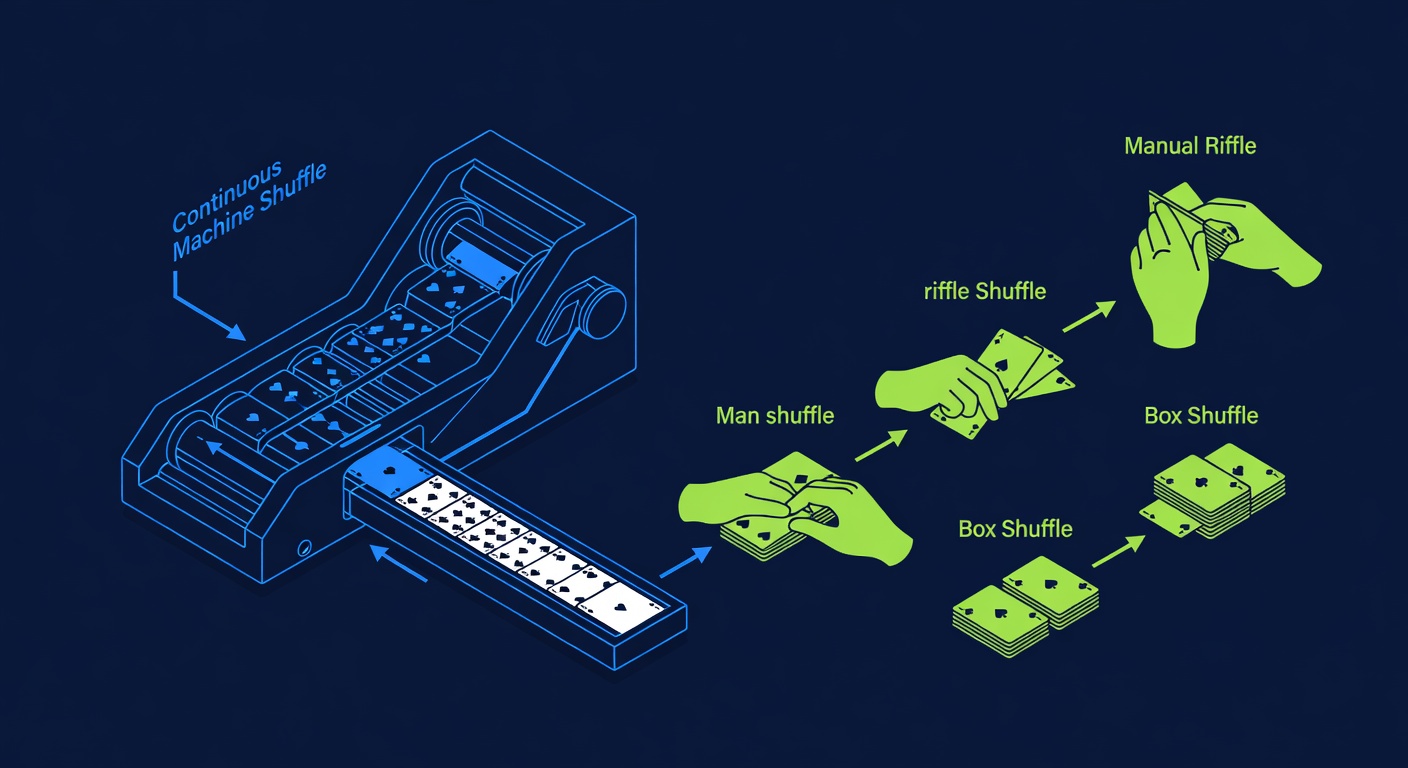
In the 1970s and 80s, some blackjack players tracked the shuffle. They watched the dealer shuffle the cards. They followed sequences. They knew which cards came next.
The advantage was real. Not huge, but real. A skilled tracker could get a 2-3% edge against the house.
Modern casinos have made this nearly impossible.
How Shuffle Tracking Worked
A dealer shuffles a shoe of cards. A skilled player memorizes the shuffle pattern. They know that the top fifty cards (roughly) will appear in a specific order.
So when the deal begins, they can adjust their bets. If they know the next six cards are aces and face cards (good cards for the player), they bet big. If the next six are small cards (good for the house), they bet small.
This requires extraordinary memory. Card counters memorize card positions. Shuffle trackers memorize shuffle patterns. It's technically possible.
Why It Stopped Working
Modern casinos use continuous shuffling machines (CSMs). A CSM shuffles cards between every hand. The shuffle pattern is randomized. No human can predict it.
Casinos also:
- Rotate multiple dealers
- Change shoe compositions
- Use decks with specific back designs (making it harder to identify cards in the shoe)
- Vary the shuffle itself (sometimes cutting before the shuffle, sometimes after)
The Math Behind It
Shuffle tracking requires knowing the position of clumps of cards after the shuffle. A clump is a group of cards that stay together through the shuffle.
A perfect shuffle would maintain card positions if the deck is cut. An imperfect shuffle (which is what casinos do to prevent card counting) should randomize positions.
But the randomization is imperfect. That imperfection is what shuffle trackers exploited.
Every measure was designed to eliminate the patterns that shuffled-tracking could exploit.
Modern Casinos' Response
Once casinos understood the vulnerability, they responded:
- Multiple shuffles (one shuffle isn't enough; multiple shuffles randomize completely)
- CSMs (eliminate the need for shuffling entirely)
- Changing dealer technique (remove consistency that trackers could exploit)
- Game variation (change rules, deck composition, shoe placement)
Every measure was designed to eliminate the patterns that shuffled-tracking could exploit.
Is It Still Possible?
Theoretically, yes. A sufficiently skilled player with an extraordinary memory could potentially track shuffles in a live casino that uses traditional shuffling.
Practically, no. Modern shuffle procedures are designed to prevent this. And casinos actively watch for shuffle trackers.
If a player is observing the shuffle intensely, taking notes, tracking patterns, the casino will ask them to leave.
The Evolution
This is the story of casino security: players find an edge, casinos close it.
Card counters found an advantage (counting high cards vs low cards). Casinos responded (shoe penetration, continuous shuffling, multiple decks).
Shuffle trackers found an advantage (tracking clumps through shuffles). Casinos responded (multiple shuffles, CSMs).
Each countermeasure made the game slightly worse for players who want to win through skill.
Now, virtually all casino games are designed so that no amount of observation can give you a meaningful edge. You can't count. You can't track. You can't predict.
What Remains
Blackjack still has the lowest house edge (around 0.5% with perfect basic strategy). But you can't beat that edge through play. You can only minimize it.
Everything else (roulette, baccarat, craps) has an edge you can't overcome with skill or observation.
The Lesson
Shuffle tracking is a historical artifact. It was real. It worked. And then casinos made it impossible.
This is why the narrative of "the guy who beat the casino" doesn't work anymore. The casinos have closed every edge.